Solar Republic
Solar design and installation, Auckland Full site migration, blog and projects included
A solar installer that designs, supplies and fits its own systems moved its entire site across: every page, the blog, and the write-ups of installations already on roofs around the country. The interesting part is what happened afterwards. The requests that used to arrive as tickets turned into things the client now does for itself, and the ones that are still ours became features of the platform.
What the site looks like today.
Screenshots taken from the live site, not from a mockup or a design concept. The installation photography is the client's own, shot on the roofs their crews worked on. The structure around it is ours.
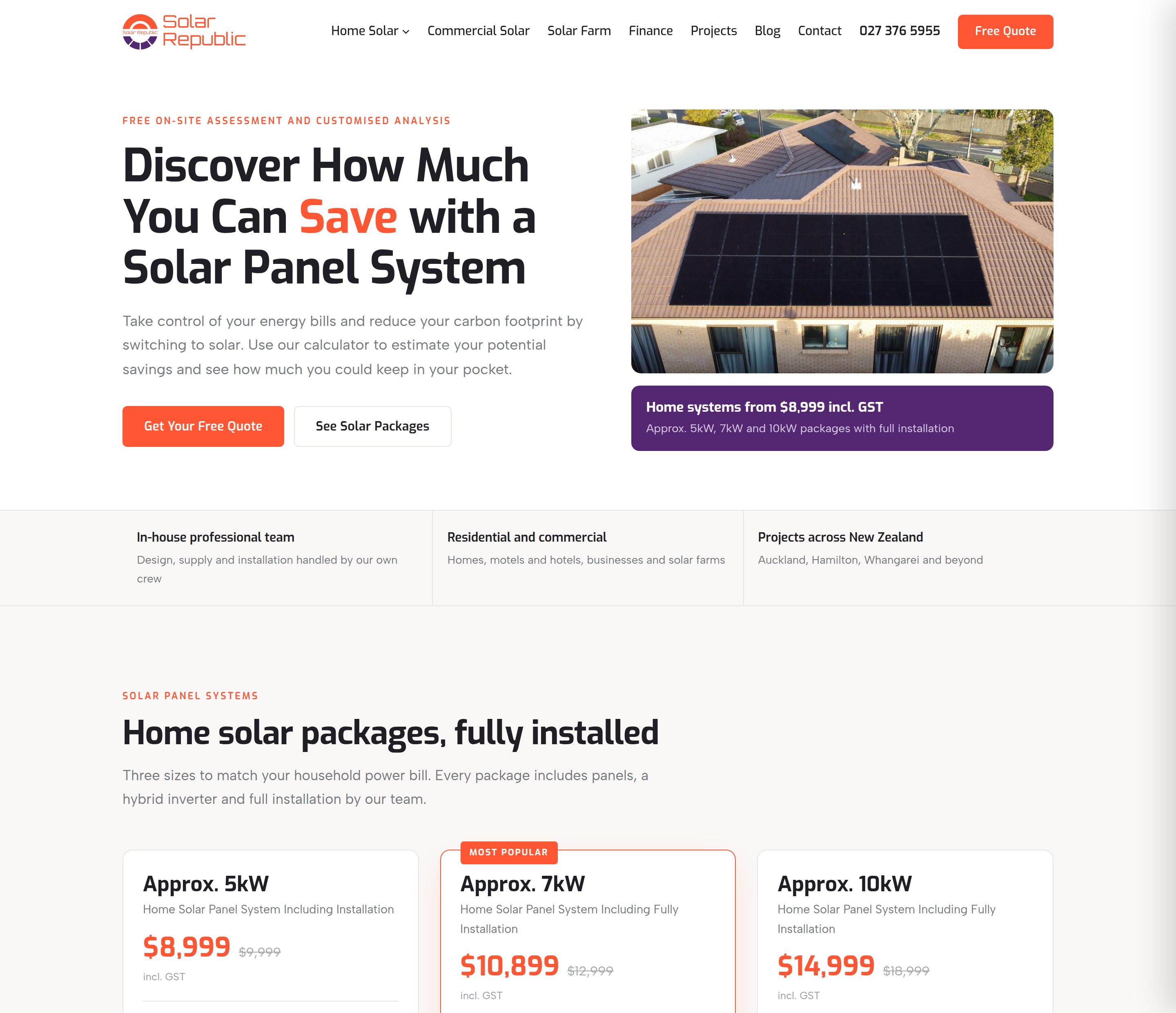
The homepage. A quote request and a savings calculator at the top, then the home system packages, because a homeowner reading about solar is trying to answer two questions in this order: will it work here, and what does it cost.
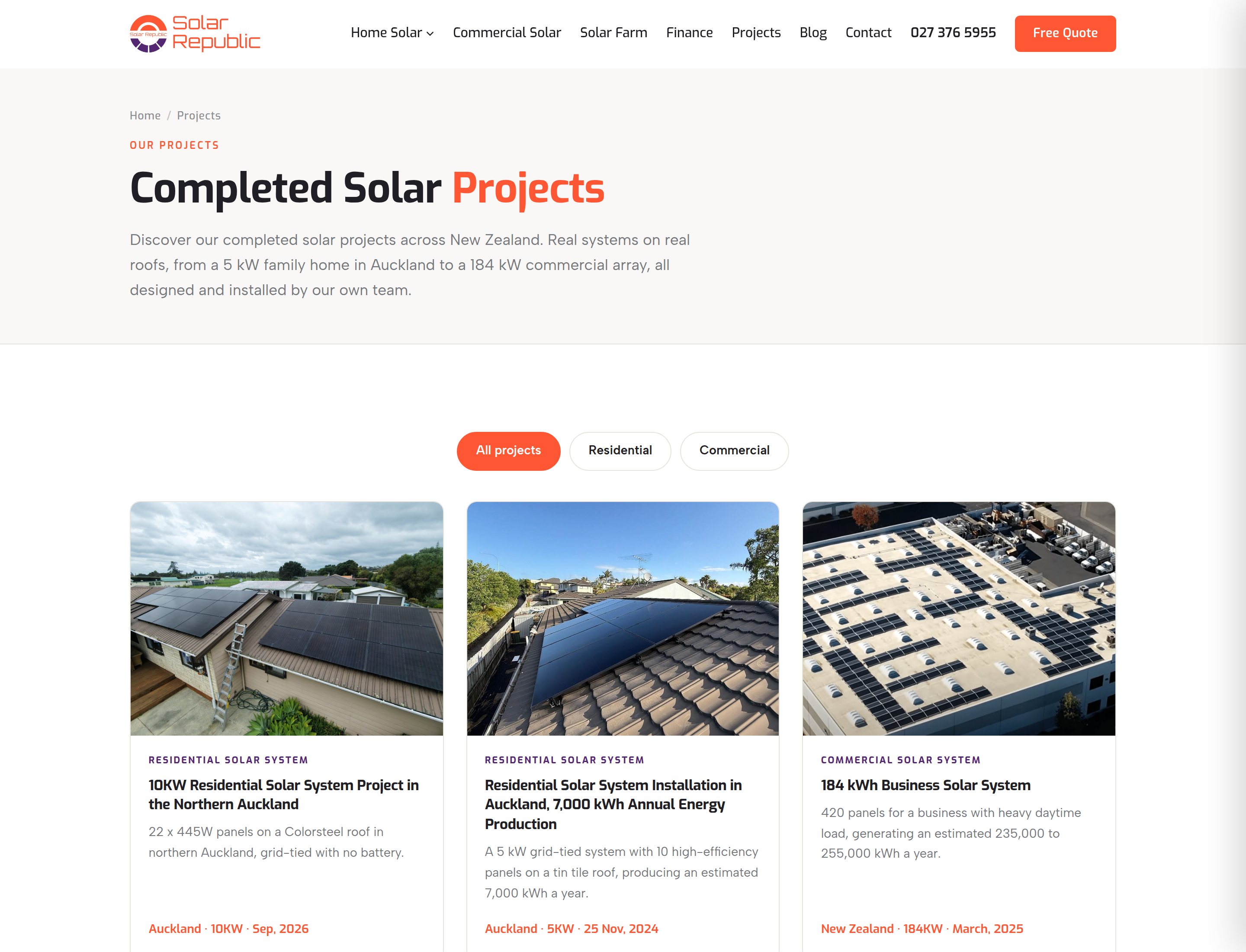
Completed projects, filtered by residential or commercial, each card leading to a page of its own with the system details, the gallery and video from the job. The client adds new ones here without asking us.
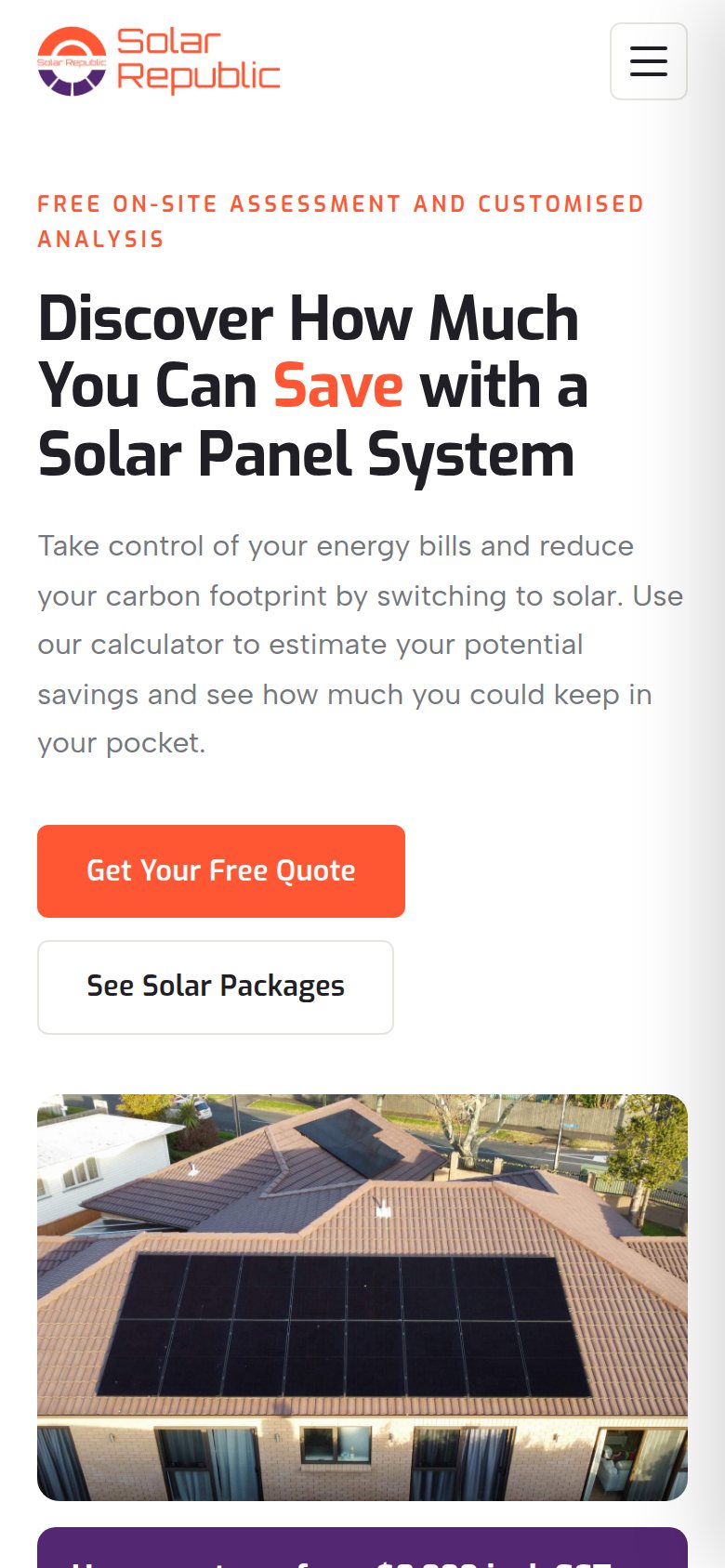
The same homepage at 390 pixels wide. The quote button is full width and reachable with a thumb, and nothing scrolls sideways.
A site with real history behind it.
This was not a business starting from nothing. The site being replaced had years of work in it: service pages for homes, businesses and solar farms, a blog answering the questions New Zealanders actually ask about subsidies and buy-back rates, a system size calculator, and a set of completed installations written up with photographs and output figures. Search engines knew those addresses. So did the links pointing at them.
That makes a migration a preservation job before it is a design job. The page titles and descriptions had to come across, the ones that were weak had to be improved rather than dropped, the blog moved to a different address shape and so needed redirects written for every post, and the project write-ups had to survive with their images and their numbers intact. Everything after that, the shop, the feeds, the self-service, was only possible because nothing was lost in the first step.
A site that carries its past and adds a shop.
Every page, with its address and its metadata
Service pages, the blog, the calculator and the legal pages all came across. Titles and descriptions were migrated rather than regenerated, and the weak ones rewritten. Where the address shape changed, a redirect was written for each old post so links and search results still land on the right page instead of a polite apology.
A shop bolted onto a service business
The home system packages became real products with their own pages, specifications, inclusions, exclusions and installation terms, and a working checkout behind them. The free quote request is still the main path, because most solar jobs need a site visit, but a homeowner who already knows what they want is no longer forced to fill in a form to say so.
Completed projects as a content type
Each installation is an entry with its own detail page: system size, panel count, roof type, location, an image gallery and a video if the crew shot one. The list filters by residential or commercial and puts the newest first, and the package pages pull recent projects in, so a homeowner comparing sizes sees roofs rather than adjectives.
Feeds Google can read
The platform generates the product feed for Merchant Center from the catalogue, with stable item ids, and a local inventory feed alongside it using the same ids. Both regenerate when the catalogue changes, so a price edited in the dashboard reaches Google Shopping without anybody editing a file and resubmitting it.
What happens when this client asks for something.
This is the part that does not fit in a feature list. The pattern here is worth noticing: each answer left the client able to do the next one without us.
A feed that updates itself
The ask. Merchant Center wanted a local inventory feed whose item ids match the main product feed exactly. The client sent us the file they had been maintaining and asked us to host it at a particular address.
What we did. We did not host the file. We taught the platform to generate that feed from the catalogue, sharing ids with the product feed and keeping the store code and collection options from their version. Now a price change in the dashboard is a feed change, with no file to edit and no chance of the two drifting apart.
Publishing their own installations
The ask. They added a project in the dashboard and found it had no page of its own, and no way to view it. The address the dashboard showed them and the address the public list used did not even agree with each other.
What we did. We rebuilt projects as a proper collection: one address for all of them, the old one redirected, a detail page each, and a workflow where the client duplicates an existing project, edits it on the page itself and publishes. New installations now go up without a ticket, and menu changes went the same way soon after.
One article, taken seriously
The ask. They pointed at a single blog post about government support for solar, named the terms they wanted it to answer for, and asked for the whole treatment rather than a title tweak.
What we did. Title and description rewritten around those terms, heading structure rebuilt, image alt text written, frequently asked questions marked up so search engines can read them, a costs section added with the packages linked from it, recent projects pulled in underneath, and the post promoted to the featured slot. One round, one delivery.
None, and nothing is missing.
Every app on the platform is included on every site at no monthly fee, which also means there is no pressure to switch one on. This site has not needed any yet.
Everything here is the platform itself
The projects collection, the shopping feeds, the redirects, the checkout, the quote forms and the editor the client publishes from are all core platform, not extras. Apps are for the capabilities a particular business needs and another one would never switch on. When this site wants one, it is already installed and there is nothing further to pay.
Installing solar, or anything else that goes on a roof?
If your best sales material is the last fifty jobs your crews finished, your site should make publishing the next one a five minute task for whoever has the photos, not a request that goes to a web developer and comes back next week. Tell us what you install, where your current site lives and how many completed jobs are waiting to be written up. WebForger is invite only, so the first step is a short application rather than a signup form.