San Michelle Bags
Luggage and leather goods retail, Auckland Migrated from Shopify
A bag and luggage shop with stores across Auckland moved its whole catalogue off Shopify without losing a single review it had earned. It now runs on our commerce kernel, where the next thing the shop needs is built into the platform rather than rented from a fourth vendor by the month.
What the shop looks like today.
Screenshots taken from the live store, not from a mockup or a design concept. The brand, the photography and the voice are the client's. The engine underneath is ours.
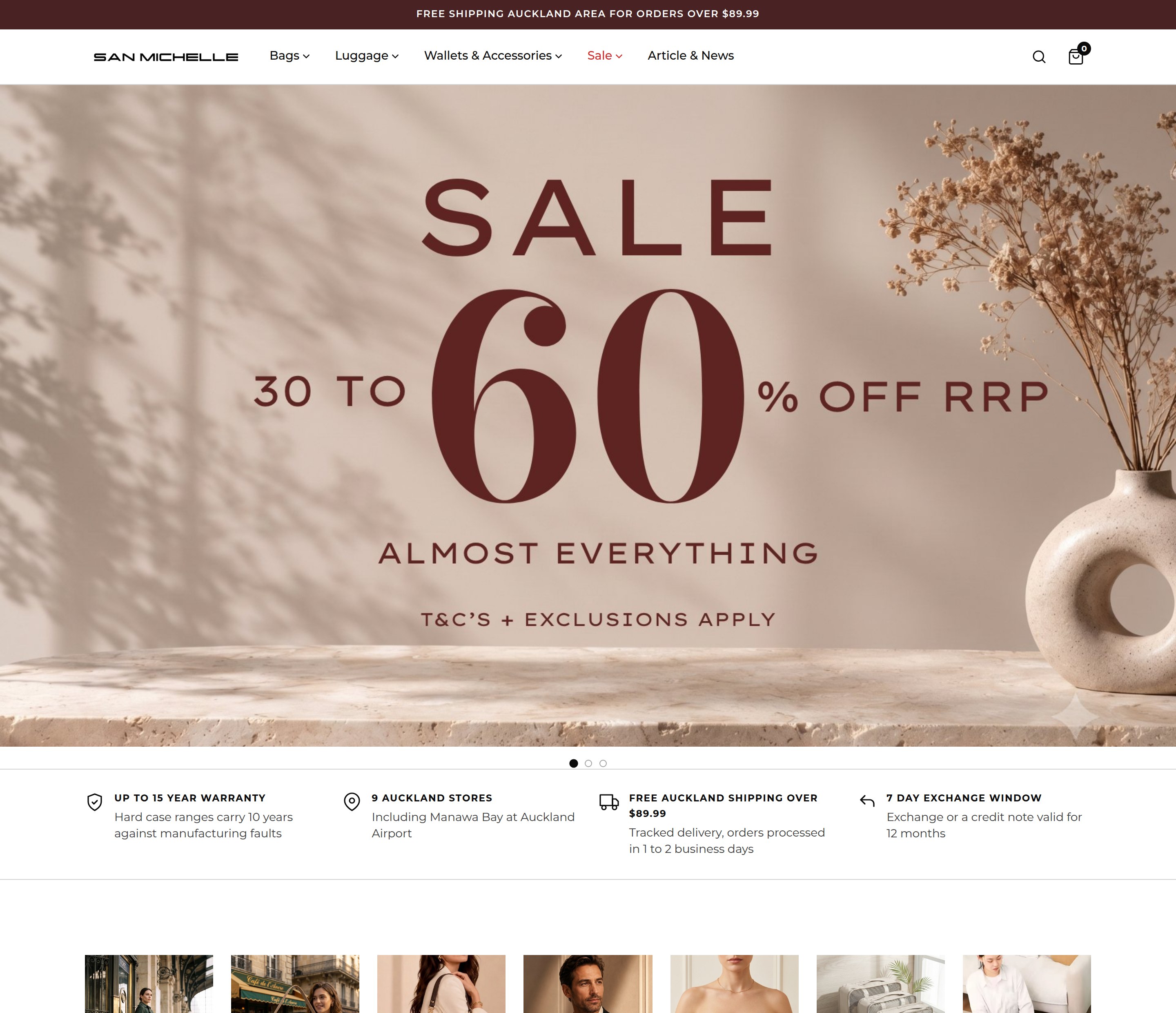
The homepage: seasonal campaign, the four promises the shop makes to every customer, then the range. Same brand as before the move, different engine underneath.
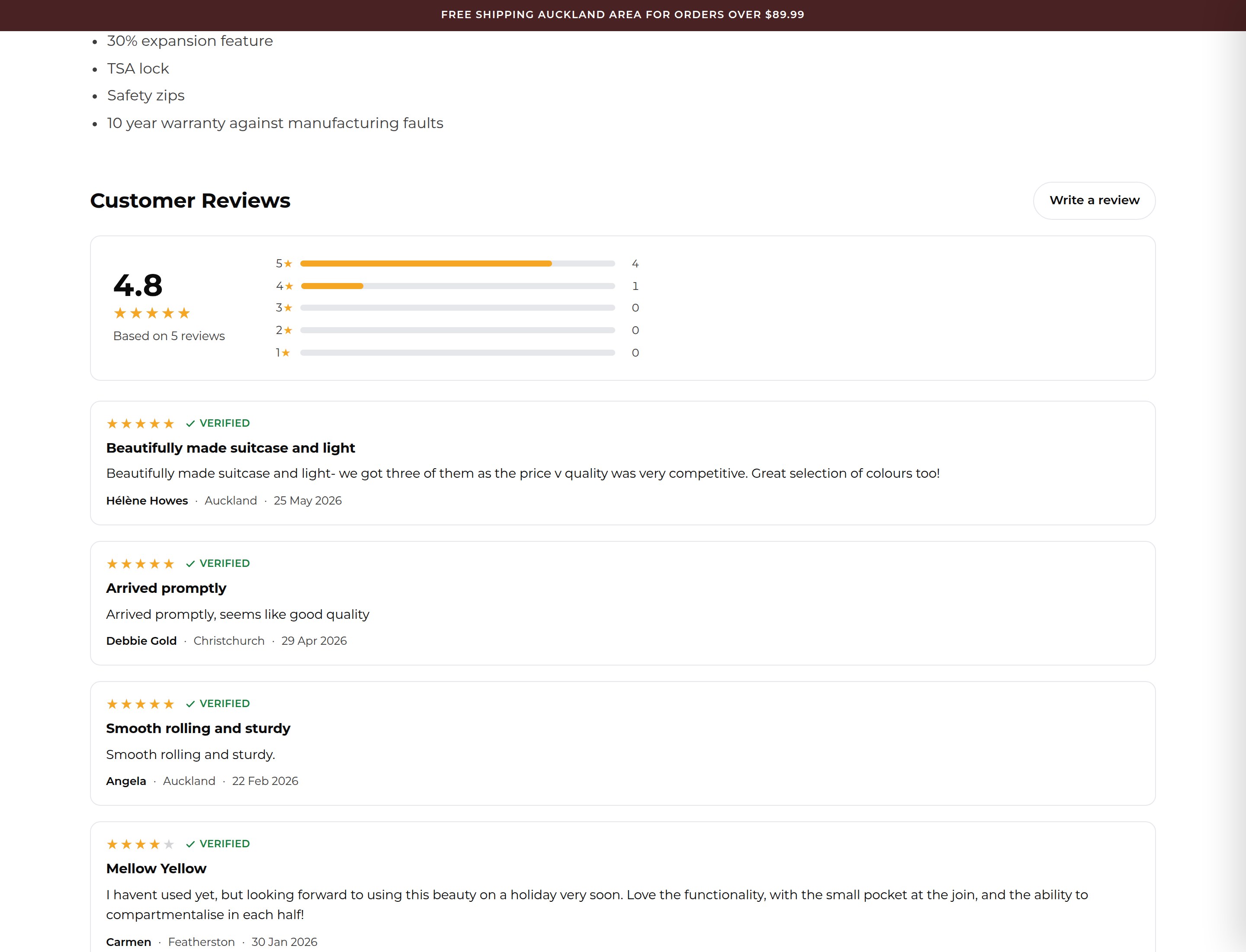
A product page review wall. Reviews brought across from the old store sit next to ones collected since, with verified purchase badges and the star distribution written into the page rather than fetched by a widget.
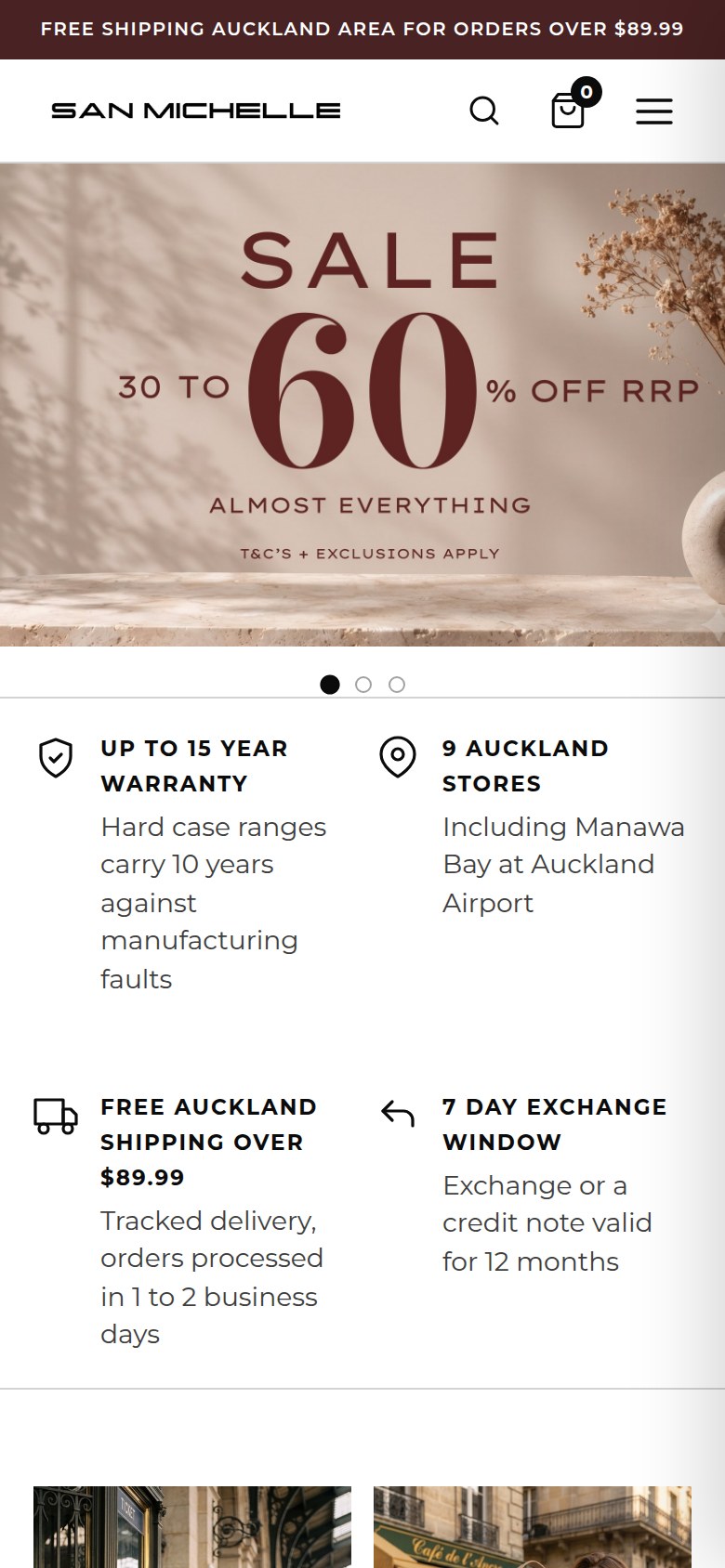
The same homepage at 390 pixels wide. Nothing important is hidden on a phone and nothing scrolls sideways.
A Shopify store paying rent on its own features.
San Michelle came to us on Shopify with the familiar arrangement: a platform fee, and then a separate monthly subscription for each thing the shop needed the platform to do. Reviews were one of those subscriptions. Anything the checkout would not do out of the box was either another subscription or simply out of reach, because the parts of Shopify that let a merchant change how an order is priced sit behind its top tier. The shop wanted more control over the storefront and a smaller number at the bottom of the monthly bill.
That made the migration itself the first hard requirement. Everything had to come across: the full product catalogue with its variants, images and collections, and the review history the shop had built up in Judge.me. A store that arrives on a new platform with empty product pages has been reset, whatever the invoice says, so we treated the reviews as part of the inventory rather than as a nice extra to sort out later.
A shop, and the machinery behind it.
A complete ecommerce kernel
Products and variants, collections, search, cart, checkout, Stripe payments, order management and shipping all come from the platform itself rather than from four vendors who have never spoken to each other. When something needs to change there is one system to reason about, and we own all of it, so nobody has to wait for a third party to agree.
Reviews, with the history intact
The reviews collected in Judge.me were imported with their ratings, dates, names and photos and mapped onto the matching products, so the shop opened on the new platform with its social proof already in place. Since then the asking happens on its own: a request email goes out after an order has been delivered, and the review that comes back can be marked as a confirmed purchase.
Collections that maintain themselves
A shop with this many sizes, colours and ranges cannot file every new arrival into every relevant collection by hand for long. Smart Collections let the shop describe a group as a rule, and the platform keeps the membership current as products arrive, change price or sell out. The rest of the store reads the same list, which matters the first time a discount is aimed at one of those groups.
A draft and preview workflow
Redesign work happens in a draft with its own private preview link. The owners look at the real thing on their own phone, mark up what they want changed, and the shop that customers are buying from does not move until everyone is happy. It is the difference between reviewing a website and reviewing a picture of one.
What happens when this shop asks for something.
This is the part that does not fit in a feature list. On most platforms a request like these becomes a search for an app that almost does it. Here it becomes a change to the platform, and every other store gets it too.
An invoice for the difference
The ask. A customer wanted to swap an out of stock item for one that cost more, and the shop had no way to collect the difference online. Reading a card number back over the phone was the only option left.
What we did. We built order editing into the platform. Lines on a paid order can be changed, and the system raises a payment link for the balance and reconciles it against the original order. It shipped inside the same ticket, and every store on WebForger has it now.
Collections defined by a rule
The ask. The shop asked whether a collection could be described by a condition, the way it used to be on Shopify, instead of every new case being filed into it by hand.
What we did. We answered the same day and shipped Smart Collections. You write the conditions, the platform recalculates the membership, and discounts, badges and the storefront all read the same list rather than three different answers to the same question.
A redesign with the shop still open
The ask. The owners pointed at an international luggage brand whose site they admired and asked for the store to be reworked in that direction, without the shop closing for a day.
What we did. We worked in a draft and sent a preview link after each pass. Layout, photography and wording went back and forth more than a dozen times. The live store kept selling throughout and changed only once, on the pass everyone agreed on.
Two of ours are running on this store.
Every app on the platform is included on every site at no monthly fee. This shop switched on the two that deal in trust.
Product Reviews
FREE
The imported history plus everything collected since, shown as a star badge on product and collection cards and a full review wall with verified purchase badges. The request emails go out on their own after delivery.
Google Reviews
FREE
What shoppers have said about the physical stores, pulled from the Google business profile and rendered as a proper section of the homepage in the shop's own type and colours. Product reviews prove the product; these prove the shop.
Running a retail store on Shopify?
If your catalogue, your reviews and your customers live on a platform that bills you monthly for the things your shop actually needs, moving is less frightening than it sounds, and nothing you have earned has to be left behind. Tell us what you sell, where the store runs now and what your app subscriptions come to. WebForger is invite only, so the first step is a short application rather than a signup form.