Ben's Curtains
Custom curtains, blinds and shutters, Brisbane and the Gold Coast Two sites, Australia and New Zealand
A curtain and blind maker with its own workshop, its own install teams and showrooms across Australia already had software running the business. What it did not have was a website connected to it. Now the site is the front door of that system: enquiries arrive inside it within seconds of being submitted, and warranty claims come in as structured records instead of as emails somebody has to read and retype.
What the business looks like online.
Screenshots taken from the live Australian site, not from a mockup. The photography, the brand and the promises are the client's. The engine underneath, and the wiring out the back of it, are ours.
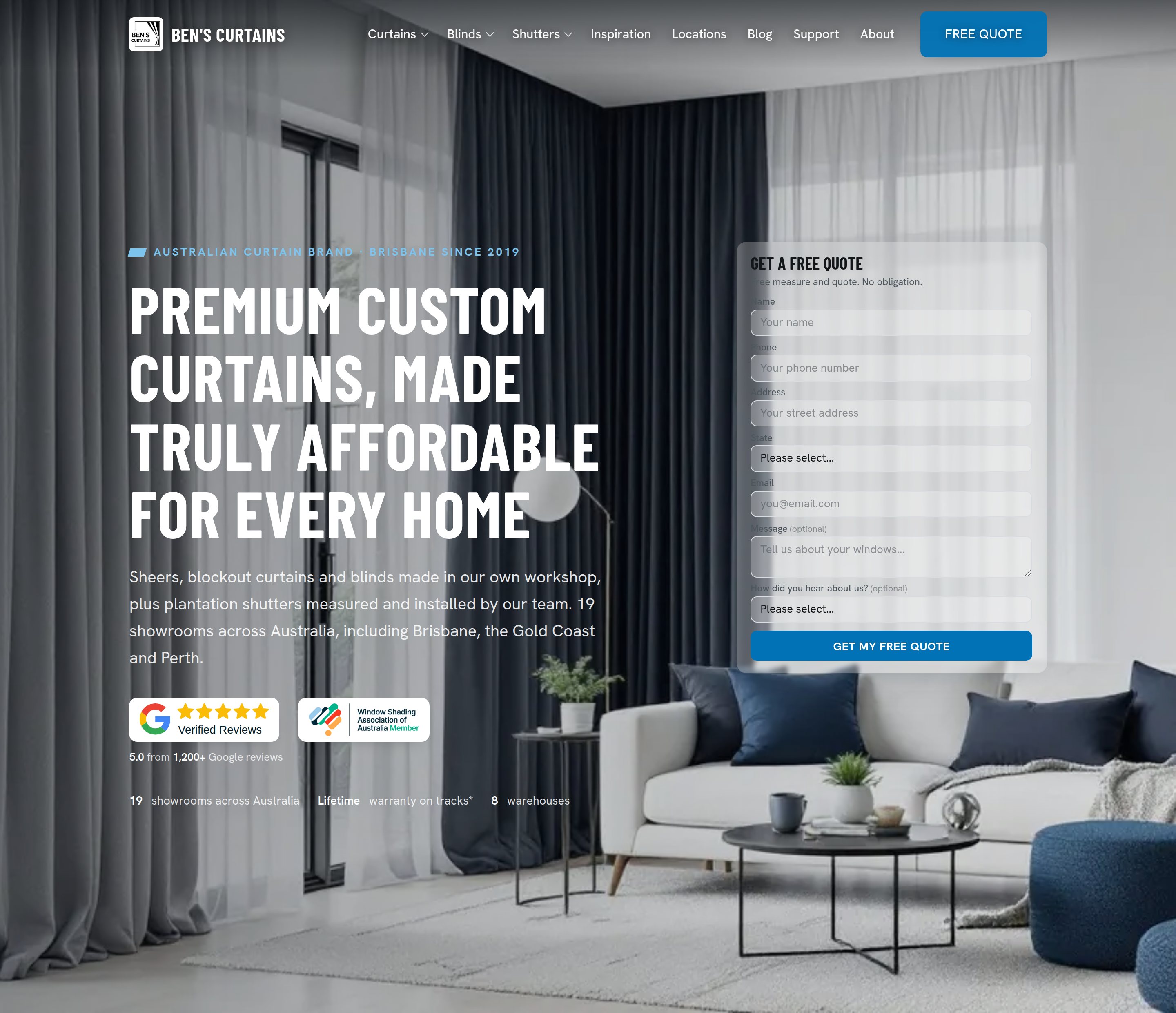
The homepage. The quote form sits in the hero rather than three clicks away, and every field in it is one the sales team actually uses when they call the customer back.
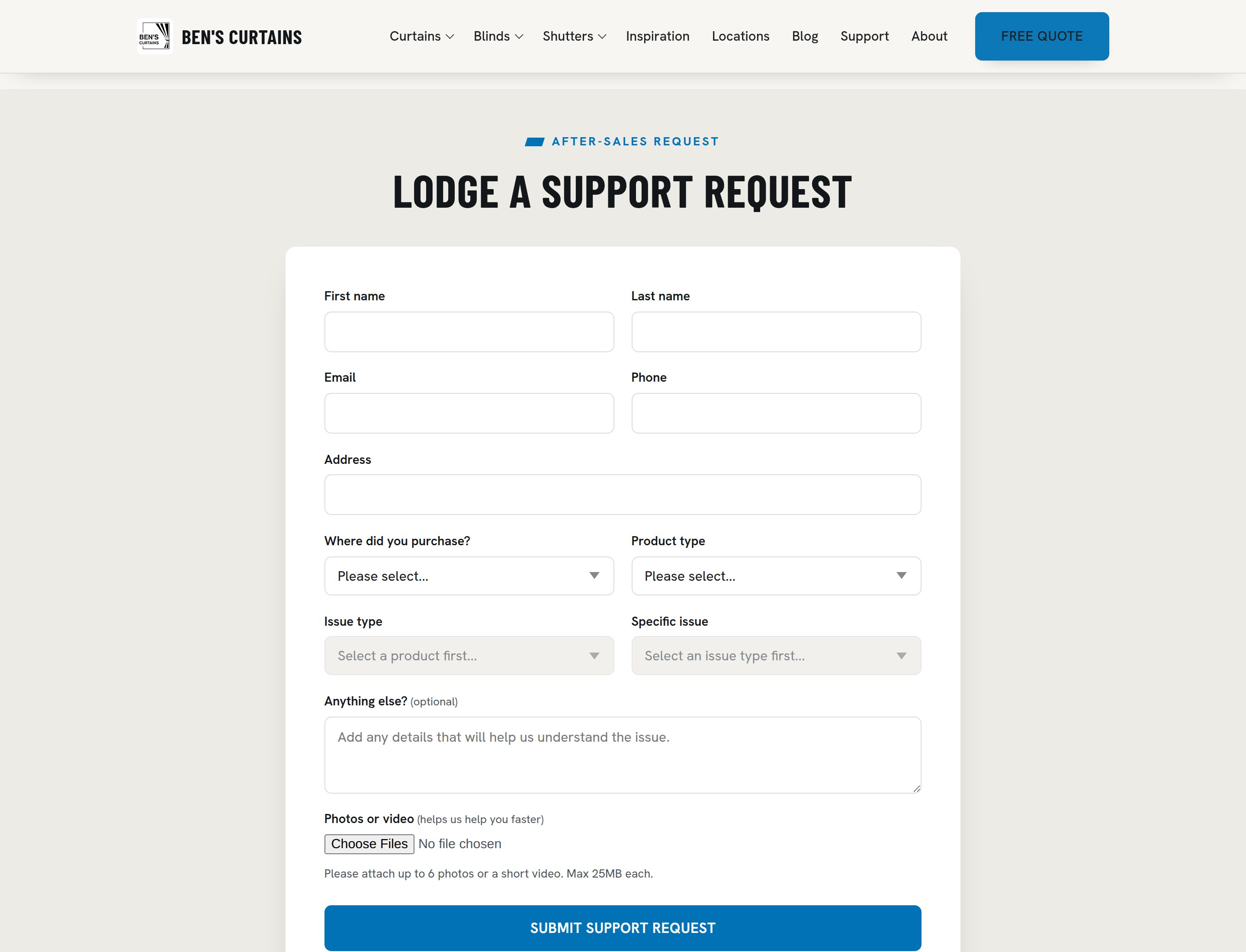
The after-sales request form. Product type, issue type and specific issue are linked, so each choice narrows the next one, and the whole thing posts straight into the client's own after-sales system.
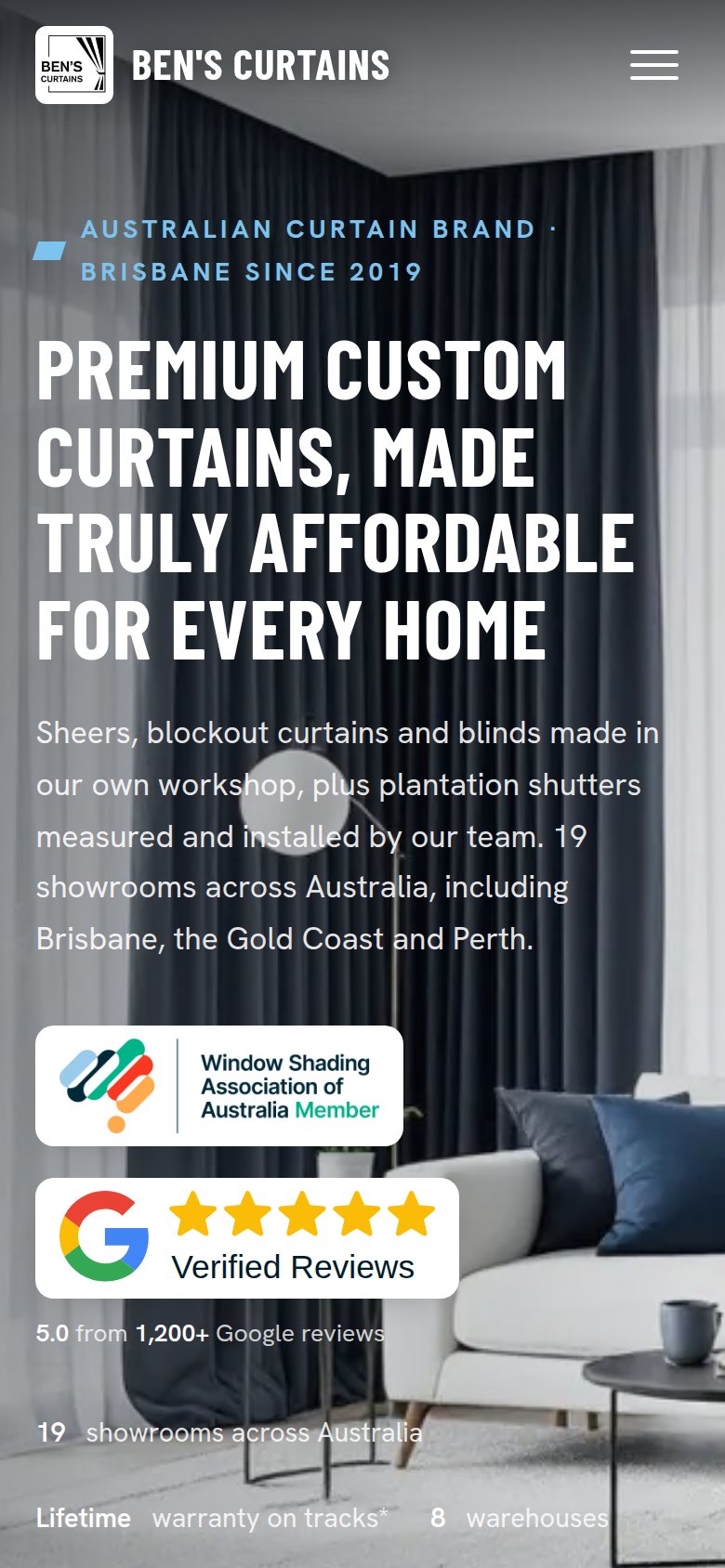
The same homepage at 390 pixels wide. The proof a customer looks for before they hand over a phone number is still the first thing they see.
A business with its own software, and a website standing outside it.
Ben's Curtains does not outsource much. Curtains and sheers are made in its own workshop, measuring and installation are done by its own teams, and the quoting, job tracking and after-sales work all run inside a business management system the company had built for itself. Two things sat outside that system. One was the website, which collected enquiries into a form and then left somebody to move them across by hand. The other was warranty and repair requests, which arrived as emails describing a problem in whatever words the customer chose.
So the brief was never really about a website. It was about making the public side of the company behave like part of the software the company already trusted, on two fronts at once: an Australian site and a New Zealand one, with the same brand, the same forms and the same destination for everything they collect. That is a different job from picking a template, and it is the kind of job that usually ends with a quote for custom development.
A front end for a system that already existed.
Two countries, one build
The Australian and New Zealand sites are separate sites with their own domains, their own showroom lists and their own contact details, built from the same components and maintained together. A change to the way a form behaves is made once. Neither site is a copy that slowly drifts out of date, which is what usually happens when a second market gets its own duplicated build.
A quote form that is an intake form
The enquiry form asks for the things a measure and quote actually needs, including the state, the street address and how the customer heard about the company. Every answer is kept, every answer is delivered onward, and none of it has to be typed twice. The form is on the homepage rather than buried behind a contact link, because the point of the page is to start a job.
An after-sales channel, not an inbox
The support page carries the company's own promise of a response within 48 hours and a request form built around the exact product and fault categories its after-sales team already works from. Photos and video go straight into the client's own storage rather than onto the website, so the site stays a website and the evidence stays with the claim.
Signed delivery of every enquiry
New enquiries are posted to the client's endpoint within seconds, each one signed so their developers can prove the request came from us, each one carrying a unique id so a repeat delivery can be discarded rather than duplicated, and each one retried on a schedule if their side is down. The enquiry is always stored in the dashboard as well, so the copy in their system is a convenience, never the only copy.
What happens when this client asks for something.
This is the part that does not fit in a feature list. Every one of these started as a message in a support ticket and finished as working software, usually with the client's own developers on the other end of the conversation.
A repair form that matches their categories
The ask. They wanted a support page carrying their 48 hour promise, with a repair request form using the product, issue and fault lists their after-sales team already works from, submitting into their own system rather than into an inbox.
What we did. We built the page and the linked dropdowns and wired it to their endpoint, with uploads going to their storage. Then the details moved: which field maps to which, where plantation shutters belong, whether photos are required. Each round went live the day it was asked for.
Enquiries in their system, seconds after they land
The ask. A single line in a ticket: how do we get the leads in real time. Their receiving software was written in house, so there was no ready made connector to point at and no vendor to ask.
What we did. We wrote them a delivery specification, signature scheme, payload, retry behaviour and all, so their developers could build the receiving end from a document. We tested against it until it verified cleanly, and when the link was live we sent the site's earlier enquiries through it as well, so their system held the history and not just the future.
Which enquiries came from the ads
The ask. Partway through the integration they asked a sharper question: does the data tell us whether an enquiry came from a paid click. It did not, and without it their own reporting could never separate advertising from everything else.
What we did. We added the Google click identifiers, the landing page the visitor arrived on and the customer's own answer to how they heard about the company, into every delivery. Attribution now happens inside the system that also holds the job, rather than in a spreadsheet beside it.
One of ours is running, on both sites.
Every app on the platform is included on every site at no monthly fee. This business switched on the one that turns showroom reputation into something a visitor can see.
Google Reviews
FREE
A company with showrooms in a long list of suburbs has its reputation scattered across a Google business profile for each one. The app reads them together and renders the reviews as part of the page, in the company's own type and colours, with the same set available to the New Zealand site rather than collected twice.
Already running your own software?
If your quoting, your jobs and your after-sales all live in a system your team trusts, the website should be feeding it, not sitting beside it collecting form submissions somebody re-types. Tell us what your system is, what it can receive and what your enquiry and warranty forms need to ask. WebForger is invite only, so the first step is a short application rather than a signup form.